RASKROI /
FABLAB REVIEW
THE EXHIBITION
RASKROI FABLAB REVIEW was the public result of an educational internship programme I ran at FabLab RASKROI. Twenty-four interns came to it from different backgrounds and different fields, and each joined one of three directions: media art, 3D printing, or digital clothing.
The programme gave them somewhere to practise and to make work of their own in that direction, under my creative direction. What went into the room at the end was three collections: Overdressed, Sensible Sea, Inception.
The world is generating demand for sustainability in production, for digitalisation, for personalised experience and for flexibility in the face of change.Interdisciplinary specialists are joining the development of the fashion industry.
Opening night was 24 February, 19:00: a VJ set with generative graphics, plus presentations by the teams themselves.
Mediations ran twice weekly for the full run, Tuesdays 19:00 and Thursdays 14:00.
METHOD
One programme, one teacher, three technologies, shown together at the end.I conceived the programme and taught and art directed all three groups.
Splitting a single cohort across three technologies rather than teaching one is the decision the whole thing rests on. It makes the show an argument about teaching rather than a display of student work, and it means the three groups can be read against each other.
The groups are peers.None of them is the lead group, and none is ranked by how much it produced.
Media-Art worked by constraint. One base garment made by the team's pattern-maker, then every member re-textured it while holding the silhouette. The variable is isolated, so what you see across the group is texture thinking, nothing else.
3D Printing worked through material reality. The group took a form all the way from Blender to a printed, finished, wearable object, which meant learning where the digital idea meets tolerance, support material and finish. It is the only group with physical outcomes in the room.
Digital Clothing worked through staging.Garment, avatar, environment and presentation all had to be built, so the group's problem was a whole image rather than a single object.
OVERDRESSED
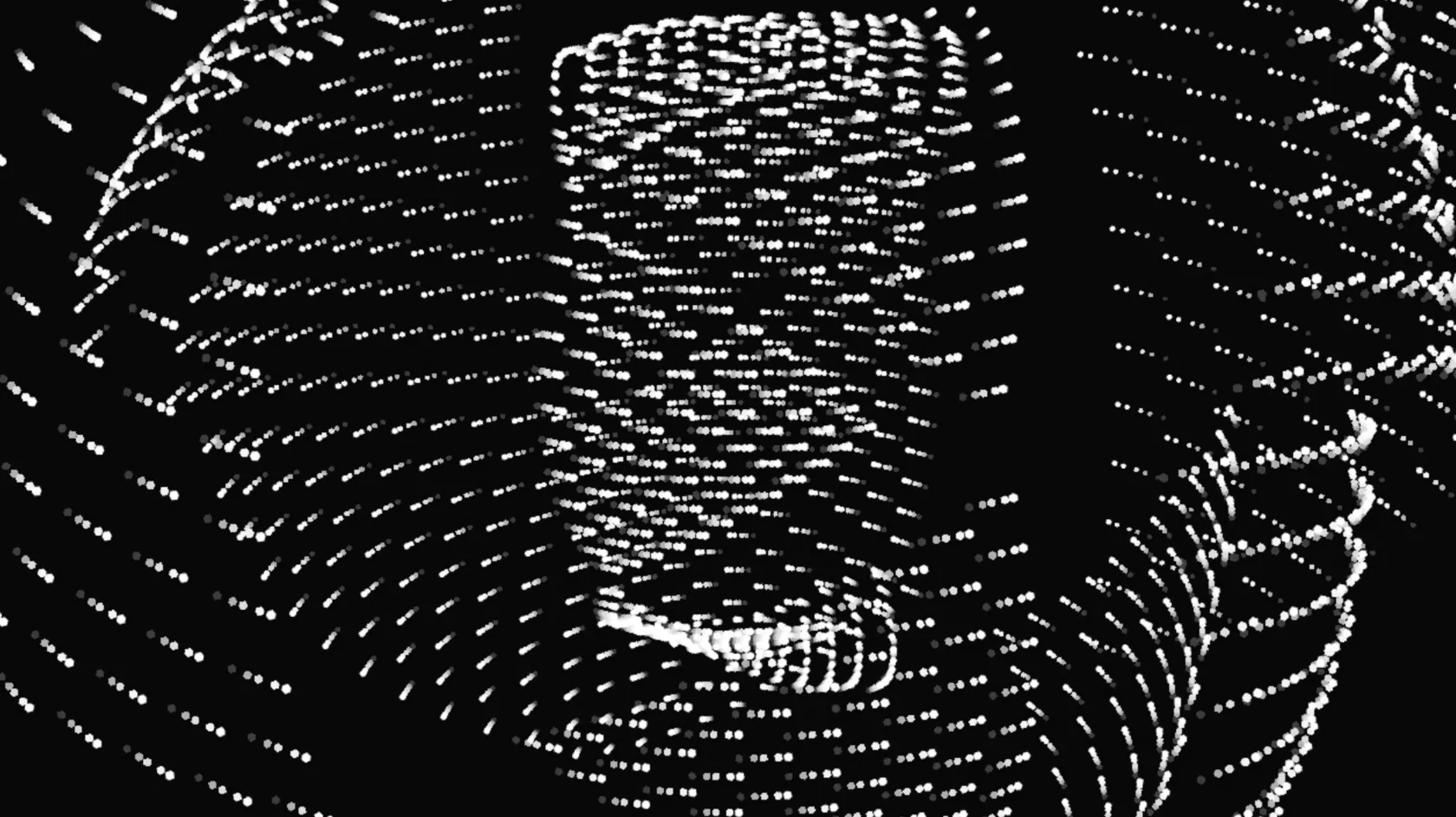
The collection by the interns of the Media-Art team is a study of different 3D textures and materials within a single look, using generative graphics.
Dress to express yourself.How can you choose one thing when there is so much in you?Overdressed.
OVERDRESSED — overload, visual noise, multiplicity, digitalisation of the physical, hyperbolisation, layered textures, the synthesis of opposites, the subconscious, the organic, decay, generation.All of it at once, and nothing a second later.
The team built one film around a single dress. Olga Kolyada, the team's pattern-maker, made the base garment. Every other participant then developed textures and transformed the dress in line with their own idea while keeping the base form intact. Across the group this produced 47 texture variations on one shared silhouette. The number is a by-product of the constraint, not the point of it: what the constraint does is isolate texture as the only variable, so the group's thinking is legible side by side.
Overdressed is about combining the uncombinable. Each participant creates several versions of the dress on the theme. For mine I used generative graphics. It is about legible forms produced artificially, and about the irreversible changes that happen.
Overdressed is a project about self-expression, form and emotion. The goal was to make something legible to everyone and visually arresting at the same time, carrying some deeper messages. The project lets every member of the team express themselves independently while still creating a single flow and a shared emotion.
Our project is work with complex textures that cannot be realised physically in the real world. Our dresses burn, shimmer like precious stones, crumble, bloom. Complete creative freedom in 3D. Seeing the familiar shape of a dress, the viewer subconsciously expects classic fabric textures and colours, but we decided to step a little further. Our project Overdressed will give you new emotions and a mild cognitive dissonance.
Our task was to create a joint project — fashion film, fashion installation, generative graphics. The team turned out to be varied in skills and directions. Our team's project is not about clothing design as such, but about a non-trivial presentation of the clothing "image" and the construction of meaning around the chosen theme, which is of course also interesting and unusual.
I am a member of the Media Art group, and we are preparing something genuinely special. We are rethinking the notion of universality of a single geometric form in the world of the metaverse, and the reflection of a person's identity within that form.
Right now, generative graphics is the loudest and brightest voice I have for speaking to the world.That is why I worked with it in the group project too.
SENSIBLE SEA
Atlantis was the source of inspiration for the 3D Printing group. Plato's legend holds that the ancient civilisation flourished as long as the divine nature was preserved in the Atlanteans. The precondition of its destruction was the material principle prevailing over the creative one. But according to cyclical cosmogony, decline and death are followed by eternal return and renewal.
In building the collection, the team drew on the idea of a change in nature that will serve as a door to a global transformation of the world. Technological fashion is developing, taking in the social agendas of freedom, customisation, digitalisation, conscious consumption and the move away from overproduction.
The hybridity of the work lies in virtual design becoming a real product when the audience asks for it.The idea becomes material.
My project is called Deep Sea Warrior.It is a women's top made of transparent silk organza, printed with a three-dimensional pattern of various artefacts of the sea: shells and ammonites.
QWATRO is a telescopic bag printed on a 3D printer. Like water in the ocean, it reacts to external impulses and is set in motion by touch, changing its dimensions. QWATRO brings together contemporary 3D printing technology and traditional beadwork: the handles are executed in the technique of volumetric tapestry weaving with cubic beads.
Smooth forms remind us of the underwater world, which is also urgent now, at the stage of mammal extinction.It should remind us how important it is to take care of one another.
I started working on the project later than the others; by the time I joined, the mood board had been assembled.I had to draw inspiration from it and create something of my own.
My project is dedicated to the human of the future, who does not destroy nature but learns to be part of it. The forms of the jewellery symbolise the complex composition of the human body and a subtle rhyme with the ecology of the oceans. The inspiration was the forms of coral reefs and the neural connections in the human organism.
The idea for the bracelet design came from the forms of various sea creatures. The shape of the model repeats the smooth movements of the thin fins of fish and the waves that spread from their motion underwater.
Project: SIMBIOSIS.Within the 3D printing project I am creating an ear cuff, using PLA plastic as the main material, which is produced from a natural raw material, corn flour.
INCEPTION
In creating their collection, the members of the Digital Clothing team drew on the process of constant technological development: the 3D world once seemed complex and remote, and now it is part of life. The group used new technological possibilities for experiments, for visualising their ideas and for design across the widest spectrum.
The world, like any individual person, strives towards perfection.INCEPTION is the beginning of the path.
This look is inspired by the fact that certain textures, such as raw iron and a fur-like brush, resemble recycled plastic and glitter, which suits our collection's overall theme of heritage and ecology.
Working on the Inception project, our team considered a great many different ideas and concepts. I was drawn to the idea of the virtual world as an ocean of possibilities and a boundless source of imagination and information.
My models were created in the flow of the team's discussion of our collection's concept, in the course of reasoning about the future, about people's values, about what they will do, how, what their priorities, values and tasks will be.
Both of my looks are about the future. We all imagine it differently. In my view clothing will not change much, because it seems to me the ideal formula for clothing has already been created, but new materials will appear that for now we can only embody in the metaverse. Comfortable, roomy clothing made of contemporary materials — that is my future.
I like collecting fabric offcuts and sewing them together: sometimes interesting combinations come out. Usually they are thrown away, but I like using them for new pieces. What inspired me for this dress was patchwork specifically — it is creative freedom and emotional release.
I have probably been dreaming in design since I was born, and my eyes are clearly different from an ordinary person's, because I see something quite different from what others see.
My source of inspiration was water, the source of life on Earth. I used three states of water: ice, liquid and gas. One avatar floats in the air, another walks under rain, and a third is in the ice.
I know everyone will see their own thing, and I hope the version presented at the show is to your liking.I am inspired by thoughts about the boundlessness of human capability.
The inspiration for these models was a period of illness and the realisation that in the new world we want to go on wearing bright, striking outfits, but we have to play them out from within new realities.
In creating the model I set myself two main tasks: 1. multifunctionality 2. secondary use The suit presented is loosely cut and aimed at everyday wear. It has a detachable cloak for windy and damp Petersburg weather.
This project grew out of conversations about the environment, problems of ecology, sea themes and the future. How much will the climate change? In my part of the project I was thinking about how a person will look in the new reality. Clothing becomes armour. It needs to be uncomplicated but still multifunctional.
OUTCOMES
Nobody briefed the three groups to converge. They were given different technologies and worked separately. Four themes came back anyway, across all three, which says something about what the material pushes people toward rather than being a coincidence.
The interns arrived without 3D backgrounds and left with work in a public exhibition.Their statements read as people discovering a medium, not as students completing a brief.
ECOLOGY AND MATERIAL RESPONSIBILITY
Mycelium leather, PLA from corn flour, Crazy Wool from textile waste, the move away from overproduction, ocean ecology, extinction.
CLOTHING AS ARMOUR
Dybok's shell for women in a toxic environment, Titova's clothing as armour, Samokhlebov's form that became armour, Pimenova's clothing as protection.
THE BODY MODIFIED
Yakovleva's hybrid human, Alyaeva's amphibian girl, Kamenskih's metamorphoses, Konopleva's three states of water.
WHAT ONLY EXISTS IN 3D
Kolyada's textures that cannot be realised physically, Deryabina's materials that can only exist in the metaverse for now.
The exhibition was covered by four outlets:
CREDITS
The programme was conceived, taught and art directed by Snezhana Paderina, across all three groups.Venue RASKROI, Kazanskaya 25. Dates 24 February to 2 April.
- Liza Kalinina
- Zhenya Kalchenko
- Olga Kolyada
- Aelia Wanderling
- Irina Zaguzina
- Darya Zakharova
- Tatiana Dybok
- Irina Eremina
- Maria Krasilnikova
- Veronika Kuk
- Sofia Morozova
- Mila Talyanova
- Tatiana Yakovleva
- Daniella Alfimova
- Anastasia Alyaeva
- Irina Degtyar
- Alena Deryabina
- Ksenia Ivanova
- Yana Kamenskih
- Natalia Konopleva
- Nikita Samokhlebov
- Elizaveta Pimenova
- Oksana Shpak
- Liza Titova